Opens in a new tab
Case Studies

Team Mechanics in the Field

Wildlife behavior in extreme environments, analyzed as team mechanics under real consequence.

By Thomas Kokta
Case Study 01

The Pair and the Colony

Visual Case Study · Steeple Jason Island, Falkland Islands
The Pair and the Colony
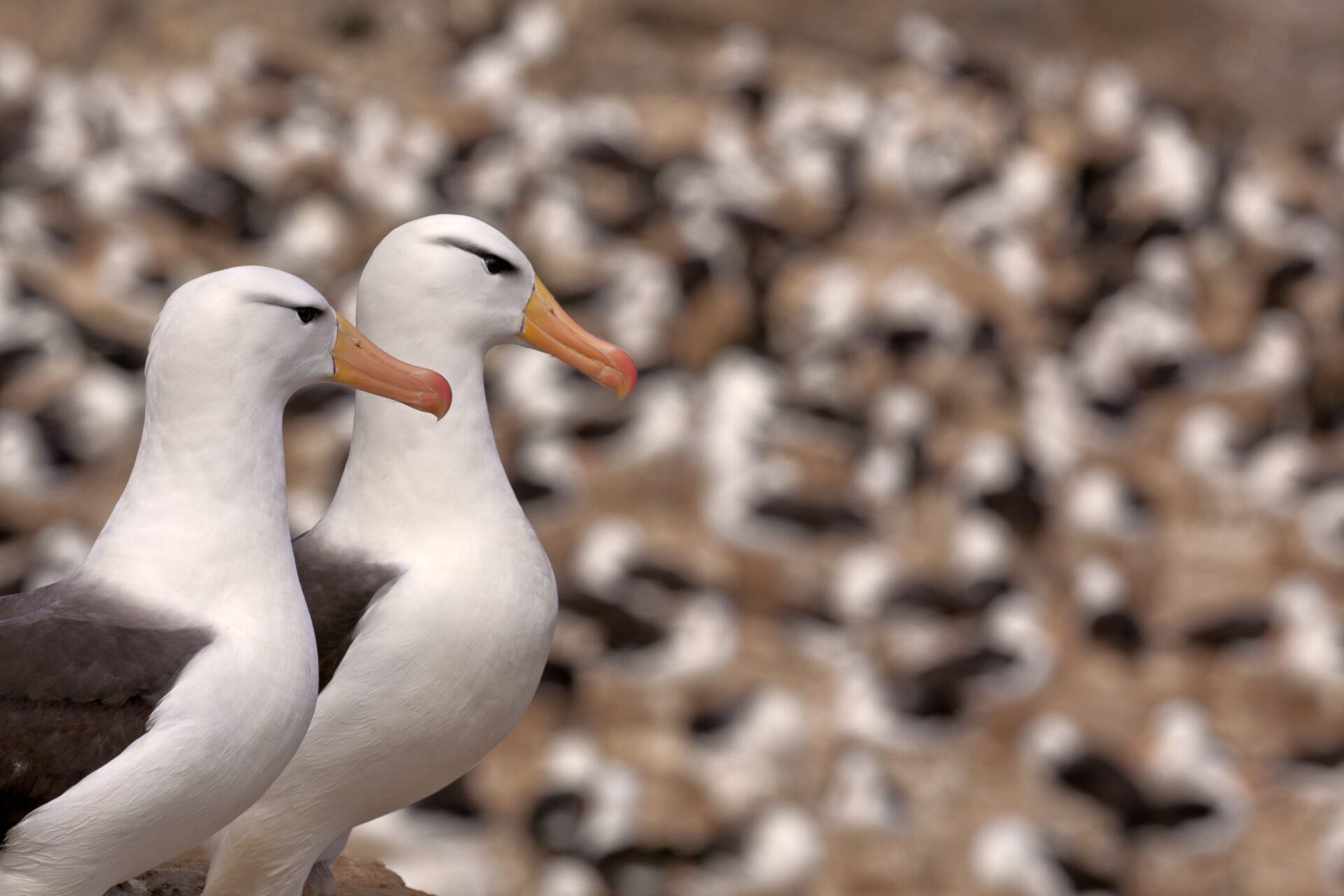
Black-browed albatross pair, Steeple Jason Island, Falkland Islands. From a series on permanent display at the Smithsonian Museum of Natural History.
Photograph: Thomas Kokta

What 150,000 albatrosses reveal about the leadership discipline of attention

Getting to Steeple Jason requires commitment.

The island sits at the northwestern edge of the Falkland archipelago. Remote even by Falklands standards, accessible only by boat and only when the sea cooperates. The landing is rocky and exposed. There is no infrastructure. What is there, in numbers that are difficult to process when you first see them, is the largest black-browed albatross colony in the world. Somewhere between 150,000 and 200,000 birds occupying every available surface, filling the air, producing a level of noise and biological density that operates on a different scale than ordinary wildlife experience.

In that environment, I made a deliberate decision.

I wanted the pair. Not the colony, the pair. Two birds, facing each other, in the specific behavioral state that albatross pairs occupy when they are together. Close, attentive, reading each other with a precision that the surrounding noise doesn’t touch. I wanted them sharp and the colony soft. I wanted the frame to do what I was observing the birds doing. To bring one relationship into complete focus while everything else receded.

This is a photograph about attention. Specifically, about the quality of attention that becomes possible when you make a deliberate choice about what to bring into focus and what to let go.

What the colony does to attention

A colony of 150,000 birds is not a background. It is a presence. Auditory, visual, olfactory, kinetic. It pulls attention constantly and in every direction. The photographer who arrives at Steeple Jason and responds to the colony as a whole is responding to the most available stimulus, which is also the least specific one. The colony is impressive. It is not the subject.

The subject required a different kind of attention. It required the capacity to narrow the frame. Not just optically, with the lens, but cognitively, with the decision about what matters in this scene and what serves only as context.

This is the Observation Economy operating at a technical level. The information in the frame is not the colony. The colony is noise. The information is in the pair. Two animals engaged in the specific behavioral language of a lifelong bond, communicating in a register that the surrounding chaos doesn’t interrupt and doesn’t touch.

What the pair knows

Black-browed albatrosses pair for life. This is not a metaphor. It is a behavioral fact with specific ecological consequences. A pair that has been together for years has developed a communication system of extraordinary precision. Posture, proximity, vocalization, the specific quality of mutual attention that signals state and intention to a partner who has learned to read it over decades.

What is visible in the frame is two animals giving each other their complete attention in an environment that is offering every possible alternative. The colony is there. The noise is there. The wind and the other birds and the constant motion are all there. And these two are looking at each other with the specific focus of creatures that have learned what matters and what doesn’t.

This is forensic empathy in its most literal expression. The capacity to read another’s precise state from the available signals, not as a general impression but as specific information. The albatross pair are not managing each other’s experience. They are reading it. Two animals that have committed to actually knowing each other rather than performing concern for each other.

"Ideas are fragile things. They require a surface to live on, and a collective mind to shape them into reality."

The leadership frame

Most leaders manage the colony. They see the team as a collective, respond to the team as a collective, calibrate their communication to the collective register. This is not incompetence. It is the natural response to an environment that presents collective stimuli at high volume and high frequency.

The leadership failure this image diagnoses is the substitution of colony management for pair attention. The leader who has never brought a specific person into sharp focus, who has never given one relationship the quality of attention that allows them to read that person’s precise state rather than their performed state, is navigating with a blurred lens.

The pair is where the real information is. The team member whose concerns are not surfacing in the group context. The colleague whose withdrawal from a conversation is communicating something specific that the collective noise is drowning out. The direct report whose performed alignment is covering something that only sharp attention would reveal.

Bringing the pair into focus requires the same deliberate decision the photograph required. Not being overwhelmed by everything else that is also present and also demanding attention. It requires the specific discipline of narrowing the frame. Choosing this relationship, this conversation, this person, while the colony continues to operate in the background.

This does not happen in the colony environment. It happens in the one-on-one, the walk between meetings, the specific moment when the leader has chosen to give one person the quality of attention that the albatross pair give each other. Complete, precise, reading rather than managing.

The compositional decision as leadership act

The decision to put the pair in focus and the colony out of focus was not automatic. It was a choice made in a demanding environment under conditions that were pulling attention in every direction. It required knowing what I came to see, holding that intention while everything else competed for the frame, and making the technical decision that served the subject rather than the most available stimulus.

This is the Discipline of the Viewfinder operating as a leadership practice. Most leaders in high-stimulus environments respond to the most available stimulus. The loudest voice in the meeting, the most recent message in the inbox, the most visible problem on the dashboard. The pair, the specific relationship that requires sharp attention, gets processed at colony resolution because the colony is always louder.

The compositional discipline is the decision, made before entering the environment, about what the frame is for. Not what will be most available. What matters.

Steeple Jason is three hours by boat from the nearest settlement, in conditions that are frequently hostile and never guaranteed. The pair was there because I went there specifically to find them. The frame was theirs because I decided, before I arrived, that they were the subject.

The leaders who consistently know what their most important relationships are communicating do not discover this in the meeting. They have already decided, before they enter the room, whose pair they are looking for.
— Thomas Kokta High Latitude Leadership

Case Study 02

The Architecture of Warmth

Visual Case Study · Antarctic Peninsula
The Architecture of Warmth
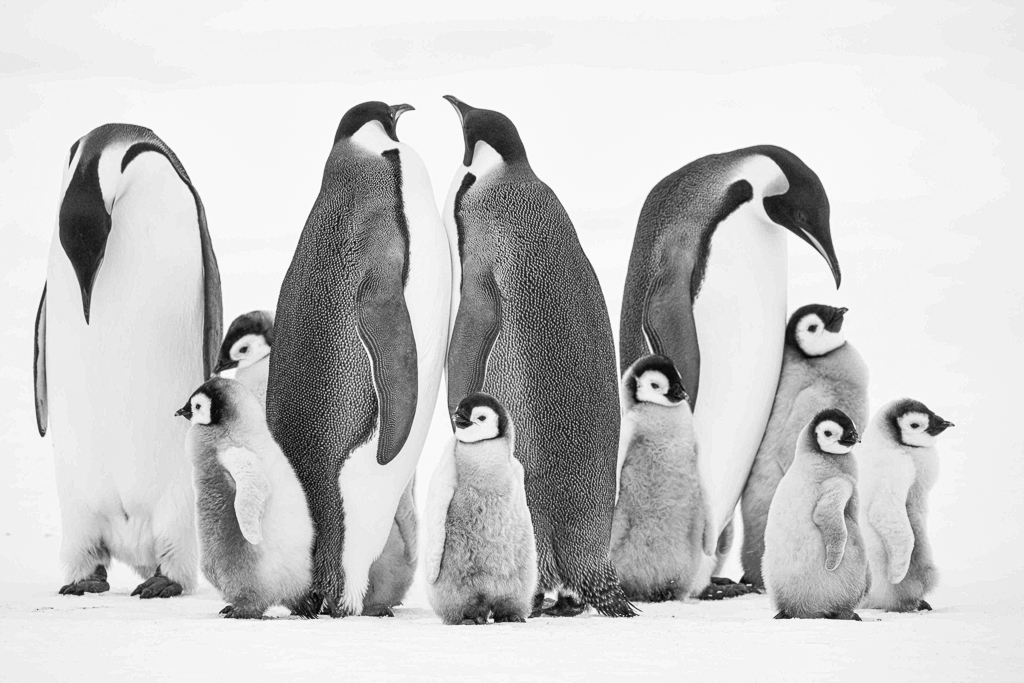
Emperor penguin crèche, Antarctic Peninsula.
Photograph: Thomas Kokta.

What emperor penguin crèche behavior reveals about strategic positioning, collective resilience, and the leader’s role in both

The white in this photograph is doing more work than it appears to be doing.

The background, pure Antarctic ice, featureless, vast, is not emptiness. It is the condition that makes everything in the foreground necessary. The temperature at an emperor penguin colony on the sea ice ranges between minus twenty and minus sixty degrees Celsius, with wind that compounds those numbers into something the body registers as a different category of cold altogether. The white surrounding these penguins is not a clean minimalist backdrop. It is the pressure that produced the architecture visible in the frame.

What you are looking at is not a family. It is a system.

Three adults, five chicks, a tight grouping in which the boundaries between individuals have become secondary to the function of the collective. One adult bends toward the chicks. Not in the sentimental gesture the posture resembles, but in the specific behavioral act of monitoring. Assessing proximity, reading the state of the young animals whose survival depends on the maintenance of this precise configuration. The chicks vary slightly in size. Different stages of development, different distances from the threshold at which they will no longer need the crèche and will join the adults in their first independent movement across the ice.

The black and white treatment is the right choice for this image. Color would have introduced the gold and orange of the adults’ markings, which are visually dominant and decorative. The monochrome version strips the image to what matters. Form, proximity, relationship, and the structural logic of a collective that is doing something precise and necessary in conditions that make imprecision fatal.

The decision that made this possible

Emperor penguins do not choose their colony location arbitrarily. The decision, made collectively, through behavioral mechanisms that are not fully understood, is one of the most consequential strategic commitments in the natural world.

The colony must be established on sea ice that will hold through the Antarctic winter and spring. Too unstable and the ice breaks before the chicks have molted their down and can survive in open water. The entire cohort dies. But the colony cannot be too far from the open ocean, because the adults must travel to feed, and in the early weeks that journey is multi-day. One parent stays with the chick. One parent makes the trip. The distance must be walkable under those conditions, repeatedly, across the feeding season.

This is a strategic positioning decision made under compounding constraint, with irreversible consequences, by an animal whose brain is the size of a walnut.

And emperor penguins get it right. Not occasionally. Every year, in every colony, the positioning decision produces a cohort that survives, or it produces a cohort that doesn’t, and that colony does not repeat the error. The feedback loop is immediate and unambiguous. There is no organizational inertia to protect a wrong decision. There is no sunk cost to rationalize staying in a position that the conditions have made untenable.

The crèche in this photograph exists because the positioning decision that preceded it was correct. The ice held. The parents returned. The collective care system could activate because the strategic foundation had been established correctly.

“The emperor penguin does not have a buffer between the positioning decision and its consequences. This is not a disadvantage. It is the condition that produces correct positioning decisions.”

What the crèche actually is

The crèche is not a daycare. It is a distributed resilience system that activates at the precise moment when individual pair-care becomes insufficient for the demands of the environment.

In the early weeks, the pair-care system is optimal. One parent holds the chick on their feet, under their brood pouch, maintaining the temperature differential that keeps the chick alive. The other parent feeds. The system is dyadic and the roles are absolute. It works because the demands of early chick development require the continuous warmth that only direct body contact can provide.

As the chick grows, the calculation changes. The chick’s thermal regulation improves. The parents’ energy reserves deplete. The feeding demands increase. The optimal system is no longer dyadic. It is collective. Both parents must feed. The chicks must pool their warmth. The adults present in the crèche are not paired with specific chicks. They are maintaining the collective temperature of the group, distributed across a configuration that has been refined over millions of years of Antarctic winters.

The tight grouping in the photograph is not warmth as metaphor. It is warmth as engineering. The configuration maximizes the thermal protection of the most vulnerable members of the system. This is the optimal solution to a specific problem, maintained through behavioral mechanisms that activate at the right moment without management overhead.

The two arguments

Two things in this image should disturb any leader who looks at it carefully.

The first: the strategic positioning decision that made this scene possible was made correctly, under conditions of extreme environmental pressure, by animals that cannot deliberate, cannot model scenarios, cannot run projections. They made the right call because the cost of the wrong call was immediate, irreversible, and cohort-level. There was no buffer between the decision and its consequences.

Human organizations have that buffer. The wrong strategic positioning decision produces declining metrics, then missed targets, then restructuring conversations, then a strategic review. Across a timeline that can absorb years of wrong positioning before the consequences become undeniable. The buffer is not protection. It is the mechanism that allows the wrong decision to compound before it is corrected.

The emperor penguin does not have this buffer. This is not a disadvantage. It is the condition that produces correct positioning decisions.

The second: the transition from individual accountability to collective resilience in the crèche is not managed by a leader. It emerges from the developmental state of the chicks and the energy state of the adults, calibrated against the environmental conditions, executed collectively without coordination overhead. The system knows when to transition because the signals are unambiguous and the response is precise.

Most organizations never make this transition cleanly. They remain in the pair-care model. Individual accountability, dyadic relationships, the leader as the thermal center of the system. Past the point where the collective model would be more effective. Not because the transition is wrong but because it requires the leader to step back from the center and trust the crèche to hold the temperature without them.

The adult bending toward the chicks in this photograph is not managing the crèche. It is monitoring it. Reading the state of the system, assessing whether the collective configuration is maintaining what it needs to maintain. This is the leader’s role in the crèche phase. Not thermal center but attentive observer, present at the periphery, checking that the system is doing what the system is designed to do.

The black and white

The decision to present this image in black and white was a compositional choice. The color version exists. The gold and orange markings that make emperor penguins instantly recognizable are visually dominant and pull attention toward the decorative, what the colony looks like, rather than the structural, what the colony is doing.

This is the Discipline of the Viewfinder applied to the image itself. Every frame is a decision about what to include and what to eliminate. Not just spatially but in the rendering. The black and white treatment is the choice that serves the subject rather than the spectacle.

The colony on the ice is spectacular. The architecture of warmth is the subject.

— Thomas Kokta High Latitude Leadership

Case Study 03

The Turning

Visual Case Study · Arctic · Minus fifty degrees
The Turning
Polar bear mother and cubs, Arctic.
Photograph: Thomas Kokta.

What a polar bear mother and two cubs reveal about the cost of the most valuable information a leader can gather

We had been there for four hours when she stood up.

The wind was toward us. This matters, because it meant she could not smell us. We had found her in the white, which took time because she was the white. A mother polar bear and two small cubs, huddled together against the cold and the wind, so completely integrated into the landscape that the eye moved past them before the mind registered what it had seen.

Minus fifty degrees. Strong wind. We waited.

The discipline of waiting in those conditions is not passive. It is a specific cognitive and physical practice. Managing your own discomfort, maintaining stillness when movement would generate warmth, staying present to a scene that is not changing in any visible way while understanding that the scene is always changing in ways that are not yet visible. Four to five hours of this. The system had forgotten we were there, or decided we were not worth the energy of a response.

Then she stood up.

My reaction, I will admit, was “oh no.” She was getting up to leave. The moment was ending without the image. She turned away, and the cubs moved with her, and she began to walk. I had the shots of her shaking the snow from her coat. Good shots, technically. But not the image.

Then she stopped. Turned around. Faced us.

One cub came to stand on her left side. One cub came to stand on her right. All three faced us.

I fired off a few shots. Then they turned and walked away.

I have been photographing polar bear cubs for twenty years. I will never see something like this again.

What she was doing

The conventional reading of this moment is emotional. A mother showing off her cubs, a wildlife encounter with an almost human quality of deliberateness. This reading is not wrong. It is incomplete.

What the mother bear did in that sequence was a specific behavioral decision made by an animal that had been assessing us for four to five hours, reached a conclusion about the nature of the threat, and acted on that conclusion with a precision that the emotional reading does not fully capture.

She got up and walked away. This was the threat response. The initial assessment that proximity required distance. The walking away is the organizational equivalent of the team member who goes quiet in a meeting. Not disengagement, but calibration. Gathering more information about whether the situation requires a response.

Then she turned back.

The return and the facing were a second-order decision. Made after the first assessment, based on information gathered during the walking away. She had concluded something. That we were not a threat, or that we were a known quantity, or that the situation warranted a different response than departure.

The flanking of the cubs is the part that requires attention. One cub on each side. This is not accidental positioning. It is the specific configuration that maximizes her coverage of both animals while maintaining her own orientation toward the perceived point of interest. The cubs are close to her body, protected from the wind by her mass, visible to her in her peripheral field while she faces forward.

She was not showing us the cubs. She was covering them while assessing us. The image that looks like a presentation is actually a protection configuration. The openness is the posture. The protection is the architecture.

“The image that looks like a presentation is actually a protection configuration. The openness is the posture. The protection is the architecture.”

The four hours

The image exists because of four to five hours of minus fifty and wind and stillness and the specific discipline of not moving when movement would have been easier and warmer and would have ended the encounter before it became what it became.

This is the Observation Economy in its most unambiguous form. The information in this image was not available to anyone who was not willing to pay the cost of waiting for it. The cost was specific. Four to five hours, extreme cold, sustained stillness, the management of the expectation that nothing might happen at all.

Most leaders approach information gathering the way most photographers approach wildlife. They move toward the subject, they signal their presence, they ask the question before the system has had time to reveal itself. The information they receive is the system’s response to being approached. Managed, curated, presented. It is real information. It is not the same information as what emerges when the system forgets you are there and behaves as it actually behaves.

The mother bear and her cubs, huddled in the white, invisible to the casual eye, were not performing. They were doing what they do. We were able to observe it because we had been still long enough, and cold enough, and patient enough, that the wind kept our presence from them until the observation was complete.

Then she made her own decision about the encounter. She turned. She assessed. She covered her cubs in the configuration that served them. She allowed the observation.

And then she left on her own terms.

What the leader learns here

There are two arguments in this image and they are in tension with each other in a way that is worth naming.

The first is about the observer. The information that is most valuable, the behavior of a system in its undisturbed state, is available only to the leader who can sustain the patience, the stillness, and the discomfort of waiting for it. Most leaders cannot. Not because they lack the intention but because the organizational environment does not reward the four-hour wait. It rewards the question asked, the meeting held, the intervention made. The observation that requires sustained non-intervention is structurally difficult to justify in any organization that measures activity.

The second is about the subject. The mother bear was not passive in this encounter. She was reading us for four to five hours while we were reading her. When she stood up, she had assessed the situation and decided to move. When she turned back, she had reassessed and decided differently. The encounter that felt like we were observing her was also an encounter in which she was observing us, reaching conclusions, and acting on them with a precision that we could only partially read from the outside.

This is the condition of organizational observation. The system you are observing is also observing you. The team member who goes quiet when the leader enters the room is not passively responding to the leader’s presence. They are actively assessing what the leader’s presence means and calibrating their behavior accordingly. The leader who understands this does not just practice the patience of waiting. They practice the discipline of being worth waiting for. Of behaving in ways that make the system’s honest response more likely than its managed response.

The most accurate information a leader receives is not the information the team brings to the meeting. It is the information that becomes available when the team has concluded, after sustained observation of the leader’s actual behavior over time, that honesty costs less than management.

That conclusion takes longer than four hours to reach. The discipline is the same.

Twenty years

I have been photographing polar bear cubs for twenty years. This sequence, the mother standing, walking, turning back, the cubs flanking, all three facing us, then turning and walking away, is something I will not see again.

This is not a statement about luck. It is a statement about cost. Twenty years of returning to the Arctic, of learning the conditions, of developing the patience to wait in minus fifty for the moment that may or may not come, of building the specific observational discipline that makes the system’s honest behavior more likely than its performed behavior.

The image is rare because the conditions that produced it are rare. The conditions that produced it are rare because most people do not pay the cost of creating them.

The mother and her cubs walked away and became the white again. The wind was still toward us. We watched them until we could no longer see where they ended and the landscape began.

— Thomas Kokta High Latitude Leadership